
Key Takeaways
- Successful real estate email marketing involves sending targeted messages based on the recipient’s needs and preferences. Segment your email list by buyer type, budget, and property interests to ensure that your emails are relevant and well-received.
- Set up automated emails to follow up quickly after open houses or when new subscribers join your list. A well-crafted welcome series and timely follow-ups increase engagement and keep leads warm.
- Regularly monitor key metrics like open rates, click-through rates, and unsubscribe rates. Use A/B testing to experiment with subject lines, content, and timing to improve the effectiveness of your email campaigns over time.

As a real estate agent, you’re juggling a lot.
You need to stay in front of clients, keep track of leads, and close deals while managing endless paperwork and market changes.
But even with all that work, many agents still struggle to connect with their audience in a meaningful way.
Sending generic emails, missing follow-ups, or not knowing how to effectively use your CRM can leave you feeling like you’re spinning your wheels.
These tips are designed to help you overcome these common pain points and make your marketing work harder for you, so you can stop wasting time and start seeing results:
Tip 1 — Send market updates that people care about
Saying the market is “crazy” means nothing, everyone says that.
To build trust, share clear, simple numbers your audience can understand, like the number of homes sold last month, average days on market, and local price trends.
Keep it straightforward with bullets and just one graph, avoid long paragraphs or essays about mortgage rates.
Start with the stats, for example: “Only 8 homes sold in Northlake this month, that’s half of last year,” then add a quick insight like, “Low inventory means sellers have the upper hand.”
And please don’t waste space thanking them for reading or talking about how much you love real estate.
Just give them the info. Be useful, not fluffy. This builds authority.
Over time, people start thinking of you as “the local expert,” which helps when they’re ready to move and need someone to trust.
Tip 2 — Stop sending generic listing blasts
No one cares about “New Listing!” unless it matches what they want.
Sending generic listings wastes your time and theirs.
People don’t want to scroll through properties they’re not interested in, and it can quickly lead to unsubscribes. Random listings won’t cut it anymore.
Segment your list so each group gets relevant alerts.
First-time buyers don’t want million-dollar lake houses, and downsizers don’t want fixer-uppers with stairs.
Break up your list by budget ranges, preferred suburbs, buyer type (first-time, investor, upsizer), and property type (condos, single-family, duplexes).
Use tags inside your email platform. Then write listings that match.
Inside the email, keep the layout simple and clean to make it easy for the reader to quickly grasp the important details.
Start with a large, eye-catching photo of the property to grab attention right away.
Below the photo, include the address and price in clear, easy-to-read text.
Add a short feature line highlighting a key selling point, such as “5-minute walk to the train station” or “Spacious backyard perfect for kids.”
Keep everything concise and visually appealing, ensuring that the focus is on the most important aspects of the listing.
This approach helps the reader immediately understand what the property offers without getting lost in unnecessary details.
When done right, these emails feel helpful and not like spam. They drive clicks from serious buyers.
Tip 3 — Automate follow-ups after open houses
Most agents lose leads after open houses because they wait too long or forget completely to follow up.
The first 24 hours matter most.
That’s when you’re still fresh in their mind.
Set up an automated thank-you email that sends within a day. Keep it short and personal.
Include links to other listings in the same price range or neighbourhood. People rarely fall in love with the first house they see.
Mention something specific if you talked to them. Even one line like, “Hope your daughter enjoyed the backyard!” makes the conversation feel human and lets them know that you are listening to them.
You don’t need to overdo it. Just be fast, friendly, and helpful.
Once set up, it runs automatically after every open house. That means zero extra work for future events, and more chances to convert casual visitors into real leads.
With real estate email marketing platform like iRealty, automating your follow-up is a quick and straightforward task that only takes 5 to 10 minutes.
The platform makes it easy to set up automated emails, ensuring you never miss a chance to stay in touch with leads.
In just a few simple steps, you can streamline your follow-up process and focus on what matters most… converting leads into clients.
Tip 4 — Build a welcome series that actually does something
When someone joins your list, don’t send them junk. Give them a reason to stick around and add value to the email.
A welcome series is three emails sent over a week or two. Not daily. Not endless.
Email 1: Quick intro with who you are, what areas you cover, and what kind of clients you help.
Email 2: Offer something free. Try a seller checklist, home valuation link, or downloadable guide. Make sure it’s easy to access.
Email 3: Share a quick success story. “Helped Jake sell in 6 days with 3 offers above asking in Lakeview.” Add proof, not empty words.
Every email should have one clear call-to-action. Don’t leave people guessing about what to do next.
Once your call-to-action is clear, the system will work for every new lead in your CRM automatically, making it easier to keep the conversation going and drive action with minimal effort.
Tip 5 — Ask clearly if someone wants to sell
Most agents are afraid to ask.
They drop hints and beat around the bush.
Just ask.
Set up an automated email to send every few months to homeowners. Say something like, “Thinking about selling your home this year? With inventory low and prices holding strong, I’d be happy to help you understand your home’s current value. No pressure, just a conversation.”
Short, clear, and non-pushy.
Best times to send? End of February (before spring), late August (before fall rush), and mid-November (catch people before holidays).
An email is like casting a net. Even if they’re not ready to act now, they’ll remember you reached out and might come back when they’re ready to take the next step.
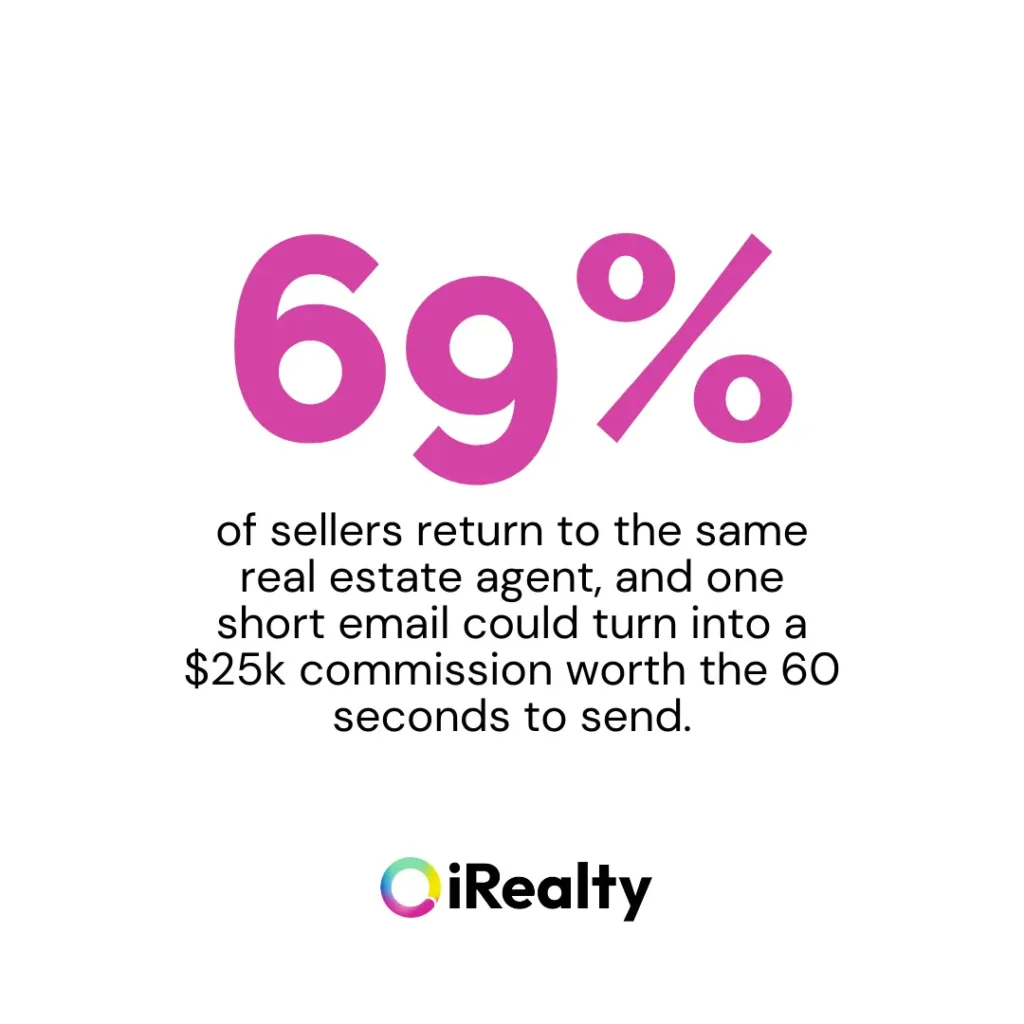
A survey from National Association of Realtors found that 69% of sellers contact the agent they worked with previously when they’re ready to sell again. And sometimes, that one email turns into a $25k commission. Worth the 60 seconds it takes to send.
Tip 6 — Make your monthly newsletter better than spam
Most real estate newsletters miss the mark.
They’re either stuffed with boring listings or just recycled blog posts no one reads. Do better.
Your newsletter should be your opportunity to stay top of mind and show your personality. Include things like local weekend events (people love these), a homeowner tip (like the best ROI upgrades), a visual market snapshot, a client win or funny story to keep it human, and a “Home Spotlight” section with a featured property photo and a call-to-action button.
Think of it like a quick update from a smart neighbor, not a brochure.
Keep it mobile-friendly, as most people check their email on their phones.
Don’t be afraid to speak like a friend. Phrases like “This one’s a total catch” or “You’ll love the open floor plan” resonate more than stiff, formal language. 63% of consumers prefer to engage with brands that speak to them in a relatable and authentic way.

Your conversational tone builds a relationship, encouraging long-term trust with your clients.
Tip 7 — Track what works and fix what doesn’t
Guessing is easy, but tracking is where the real value lies.
To improve your email marketing, focus on key metrics like your open rate, click-through rate, and unsubscribe rate. Aim for an open rate of 20% or higher, a click-through rate between 1-5%, and an unsubscribe rate under 0.5%.
By tracking these, you’ll gain insights into what’s working, what’s not, and how to fine-tune your strategy for better results.
Use A/B testing to experiment with different subject lines and content.
You should also test the timing of your emails; Tuesdays at 10 am often perform better than Friday nights.
Look for patterns in your results.
Do investors tend to click on certain properties?
Are your past clients engaging with your content?
Are your “Just Sold” emails being ignored?
Once you identify what works, double down on those strategies and ditch the ones that don’t.
Tracking these details helps you stop wasting time and start writing emails that get real results, increasing engagement, and improving your chances of converting leads into clients.
Not sure where to start? Do this today…
Getting started with email marketing doesn’t have to be complicated.
If you’re finding it too complicated for you, begin by choosing a real estate email marketing software, which makes setting up and sending emails quick and straightforward.
Start simple.
Write one follow-up email today.
Don’t worry about making it perfect.
Whether you thank someone for attending an open house or share a listing, the key is to start.
Next, link your platform to your CRM, like Vault CRM or Reapit Sales, so you never lose track of a lead.
After two weeks, take a moment to review your results.
Who opened your emails? Who clicked on the links? Use this data to refine your approach and target leads based on their actions.
The more you track and adjust, the better your results will be.
There’s no need to wait for the perfect time.
Take action now, and watch how small steps lead to meaningful outcomes.
Start today and begin building a more efficient, smarter way to connect with your leads.