
Key takeaways
- Your real estate database is full of people who already know and trust you.
- Stay organised, tag contacts clearly, and watch for seller signals like time owned and life changes.
- Send simple emails and follow up at the right time to turn quiet contacts into listing leads.
You work hard for every lead.
You run ads. You post online. You answer late night texts. You follow up with internet inquiries.
But here’s the part many real estate agents miss.
Some of your best listing leads are already inside your real estate database.
They’re not raising their hand. They’re not calling you to say they want to sell. They’re sitting quietly in your system. Waiting for the right moment.
The good news is this. You don’t need more leads to get more listings. You need a better way to read what you already have.
This idea lines up with long-running industry approach. Many sellers choose an agent through a referral or someone they already know. That means staying in touch with your database can matter more than chasing cold leads every week.
This guide will show you how to do database mining and spot seller signals. It’ll also show how to use email marketing to reach more sellers without sounding pushy.
See your real estate database as an asset, not a storage box
Before anything else, you need to change how you see your real estate database. A real estate database isn’t just names and numbers.
It’s your history with people.
It includes past clients, open home visitors, old online inquiries, referrals, and community contacts. Each one has a different level of trust with you. That trust is often your advantage.
Industry research keeps pointing to the same pattern. People often use an agent they worked with before, or someone they were referred to by family or friends. That’s why your database isn’t “old.” It’s familiar.
Your job is to turn “familiar” into “top of mind.”
Here are some steps you can do to get there.
Step 1: Sort and organise your real estate database
Database mining starts with neat data. If your database is messy, your follow up will be messy too.
Set aside time to sort them in small chunks. Even 30 minutes a week helps.
What to fix first
- Delete duplicate contacts
- Merge contacts when the same person is saved twice
- Update phone numbers and emails when you learn new ones
- Fix name spelling
- Add missing suburb, address, or property notes when available
- Remove contacts who asked to unsubscribe from emails
Create a simple structure
If you only do one thing, do this.
Tag people by relationship and stage:
Relationship tags
- Past client
- Current client
- Referral partner
- Friend or family
- Community contact
Stage tags
- Buyer lead
- Seller lead
- Investor
- Landlord
- Not active right now
Property tags
- Suburb or area
- Property type (house, unit, townhouse, land)
- Bedrooms range if known
- Purchase year if known
This structure makes it easier to spot patterns. It also makes email marketing safer. You can send the right content to the right group instead of spamming everyone.
To see why data rules matter, read your country’s privacy rules. In Australia, the OAIC explains how to collect and protect personal details.
Step 2: Find seller signals hiding in plain sight
Most future principals don’t say, “I’m selling in six months.”
They hint.
Seller signals are the hints. When you track them, your database stops being a list and starts becoming a map.
Here are seller signals that show up often.
Seller signal 1: Time owned
People often sell after they’ve owned a home for a while. They might want more space, less space, a new school zone, or a different commute.
You can use “purchase year” to build a simple shortlist.
Try these groups:
- Owned 5 to 7 years
- Owned 8 to 12 years
- Owned 13 plus years
Then look for patterns inside each group. Units can turn over faster than family homes. Investors can turn over based on rental returns, repairs, or tax planning.
This is database mining at its simplest. You’re not guessing. You’re sorting.
Seller signal 2: Life changes you already know about
People move when life changes.
Common triggers include:
- A new baby
- Kids leaving home
- New job or job loss
- Separation or divorce
- Marriage or moving in together
- Caring for ageing parents
- Retirement
- A death in the family and an estate process
If you take good notes in your CRM, you already have some of this. Review your notes and look for contacts where the story has likely changed since you last spoke.
You don’t need to be personal or nosy. You just need to be present.
A simple “How are things going with the new job?” can reopen a relationship and surface a move plan.
Seller signal 3: Investor pressure points
Investors sell for different reasons than owner occupiers.
Look for:
- Rising holding costs
- Repairs stacking up
- A tenant leaving
- Rent not keeping up with costs
- A change in lending conditions
- A goal to cash out and buy elsewhere
If you’ve landlords in your real estate database, add landlord tags and note lease end dates when you can.
You can also share general information about tax and sale timing. You can then recommend they speak with their accountant for personal advice.
If you write about capital gains rules, use official sources, not opinions. A good example source would be the Australian Taxation Office’s capital gains tax overview.
Seller signal 4: “Soft intent” behaviour
Soft intent is when people start looking around, but they’re not ready to call you.
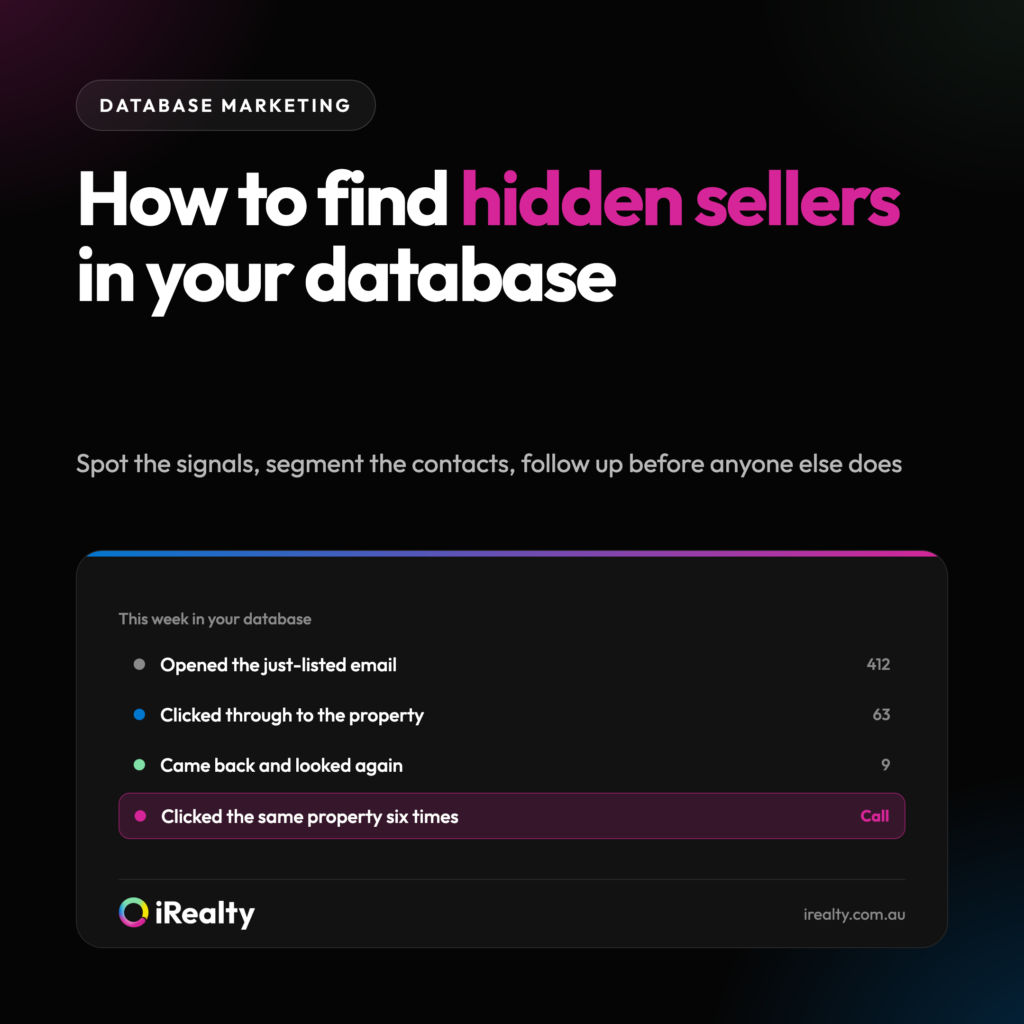
If your systems track engagement, watch for:
- Clicking on sold results emails
- Saving homes that look like a “next step”
- Asking for a market update
- Replying with small questions about timing or price
- Visiting your website selling page more than once
If you don’t have tracking, you can still spot soft intent through conversation.
Someone who says, “We’re just keeping an eye on the market,” is often closer to selling than they admit.
Step 3: Build targeted segments for database mining
Segmentation means grouping people so you can speak to them in a useful way.
It helps you avoid two problems:
- Sending the same message to everyone
- Only contacting people when you want something
Here are segments that can help produce listing leads.
Segment A: “Owned 7+ years” homeowners
This is your steady pipeline.
They may not sell today, but many will sell eventually. Your job is to stay in their world so you’re the first call when the idea turns serious.
Segment B: Past buyers in starter homes
If someone bought a smaller home and their family grew, they may be an upsizer.
Your emails to this group can focus on:
- What larger homes are selling for
- How to plan a sale and purchase without stress
- Timelines for selling first vs buying first
Segment C: Past sellers and past listing appraisals
Past sellers already know the process. So, they may sell again or refer others.
Keep them updated and make it easy for them to introduce you.
Segment D: Landlords and investors
Different content works here:
- Rental market snapshots
- Lease timing reminders
- Renovation and maintenance planning
- General policy and rate news with links to official sources
For interest rate changes, link to central bank updates, not hot takes.
Segment E: Cold leads that never converted
Some leads go quiet because timing was wrong, not because they disliked you.
A gentle re-engagement plan can turn “dead” into “active.”
Step 4: Use email marketing to find more listing leads
Email works when you treat it like a helpful check-in, not a billboard.
You’re not trying to win in one email. You’re trying to stay remembered.
Keep your emails simple
Aim for:
- One topic per email
- Short sentences
- A calm tone
- One practical next step
A good next step is often “Reply and I’ll send you a quick update.”
Follow email rules and protect trust
Email marketing is regulated in many countries. You should follow the rules for consent, identification, and unsubscribe options. For example, Australia follows the ACMA spam rules and guidance.
This isn’t legal advice, but the simple standard is easy to follow.
Be transparent of who you’re. Make it easy to opt out. Only email people you’ve a real reason to email.
Trust builds listings.
Email type 1: Local market update
This one works because it’s relevant to homeowners.
Send a short update with:
- 3 recent sales in their suburb
- The price range
- Days on market
- A plain summary of what that means
End with a soft offer:
If you want a quick price estimate for your home, reply with your address and I’ll send it through.
Email type 2: Home value check-in
This is a direct way to surface hidden sellers.
Send to “Owned 7+ years” and “Past buyers.”
Keep it calm. Here’s a sample email you can send.
Subject: “Want an updated home value?”
Body: “Hi [Name], I’ve been updating recent sales in [Suburb]. If you want a quick price guide for your home, reply and I’ll put one together. No pressure.”
This email doesn’t need charts. It needs clarity.
Email type 3: Seller prep checklist
People often delay selling because they think it’ll be hard.
But a checklist reduces stress and gets replies.
Your checklist can include:
- Declutter one room at a time
- Fix small items that buyers notice
- Do basic sorting
- Gather documents you already have
- Plan where you’ll go if you sell
You can also link to a reputable general guide on selling steps. For example, you can link the ACCC consumer info hub.
Keep your checklist focused on “what to do first” not “do everything.”
Email type 4: Re-engage older leads
Here’s a short and effective sample.
Subject: “Still thinking of moving this year?” Body: “Hi [Name], we spoke a while back about a move. If your plans are back on the table, tell me what you want next and I’ll send a few options. If not, no problem.”
The “no problem” line matters. It lowers pressure.
Email type 5: The “two options” email for warm contacts
This email works well when you already see seller signals.
Subject: “Quick plan for your next move” Body: “Hi [Name], if selling is on your mind this year, there are usually two paths.
- Sell first, then buy.
- Buy first, then sell.
If you tell me your rough timing, I can share what usually works best in [Your Area].”
This invites a reply without pushing for an appraisal.
Step 5: Call when the data says “now”
Email creates signals. Signals tell you who to call.
Call when someone:
- Replies to a market email
- Clicks your “home value” link
- Asks a timing question
- Mentions a life change
- Starts browsing similar homes again and again
When you call, keep it short:
- Name the reason you called
- Ask what has changed
- Offer a next step that’s easy
Example:
Hi Sam, I saw you clicked the sold results in [Suburb]. Are you just keeping an eye on prices, or is a move getting closer? If you want, I can give you a rough price range and a simple timeline.
This feels normal. Not salesy.
Step 6: Turn conversations into a simple seller pipeline
When someone shows interest, you need a detailed next step.
A basic pipeline could look like this:
- Warm signal spotted
- Short call
- Offer a price guide and timing chat
- If interest continues, book a walk-through
- Provide a written plan (prep, pricing range, timing, marketing options)
- Follow up weekly or every two weeks depending on their timeline
The written plan is important. It shows you’re organised. It also helps them talk to a partner or family member.
Step 7: Make database work a weekly habit
You don’t need a big campaign every month. You need a routine you can keep.
Here’s a simple weekly plan:
- Monday: Sort 10 contacts and add tags
- Tuesday: Check who opened and clicked your last email
- Wednesday: Call 5 warm contacts
- Thursday: Write one email for one segment
- Friday: Add notes and set follow-up tasks
Small steps stack up.
Over time, your real estate database becomes a steady listing lead engine. After all, you’re always doing light database mining.
Step 8: Measure what works and adjust
Track simple numbers:
- How many replies you got this month
- How many valuation requests came from your database
- How many listing appointments were set
- How many listings were won
- Which email topics got the most replies
A basic spreadsheet works to monitor data. But a real estate email marketing platform offers these insights. It lets you know easily what works and what doesn’t.
If market updates get replies, keep doing them. If check-ins get replies, run them more often. If a topic gets no response, drop it.
This is how you build a system that fits your market and your style.
Spend less time chasing after new clients
Your real estate database isn’t just old leads.
It’s people who already know you, or at least remember you. Industry research shows sellers often work with agents they know or who were referred to them. That’s a strong reason to treat your database like a real business asset.
When you organise contacts, track seller signals, and segment them, database mining becomes simple. You stop guessing. You start seeing patterns.
Then email marketing becomes useful instead of annoying. You send short updates that help people understand their home value and their options. You call at the right time. You follow up like a pro.
This is how you find hidden sellers sitting quietly in your system. And this is how you turn them into listing leads, without burning money on constant new lead chasing.
Do it yourself or let iRealty do it for you
Everything in this guide is something you can do on your own. Or you can let iRealty do it for you automatically, in minutes instead of hours.
Here’s what iRealty takes care of.
- Database organisation: Sort, tag, and segment your contacts without extra paperwork
- Seller signal tracking: Spot who’s ready to move based on time owned, behaviour, and life stage
- Segmented email campaigns: Send the right message to the right contact at the right time
- Automated follow-up messages: Stay in touch without doing all the work yourself
- Engagement tracking: See who opens, clicks, and replies so you know exactly who to call
Your hidden sellers are already in your database. iRealty just helps you find them faster.